
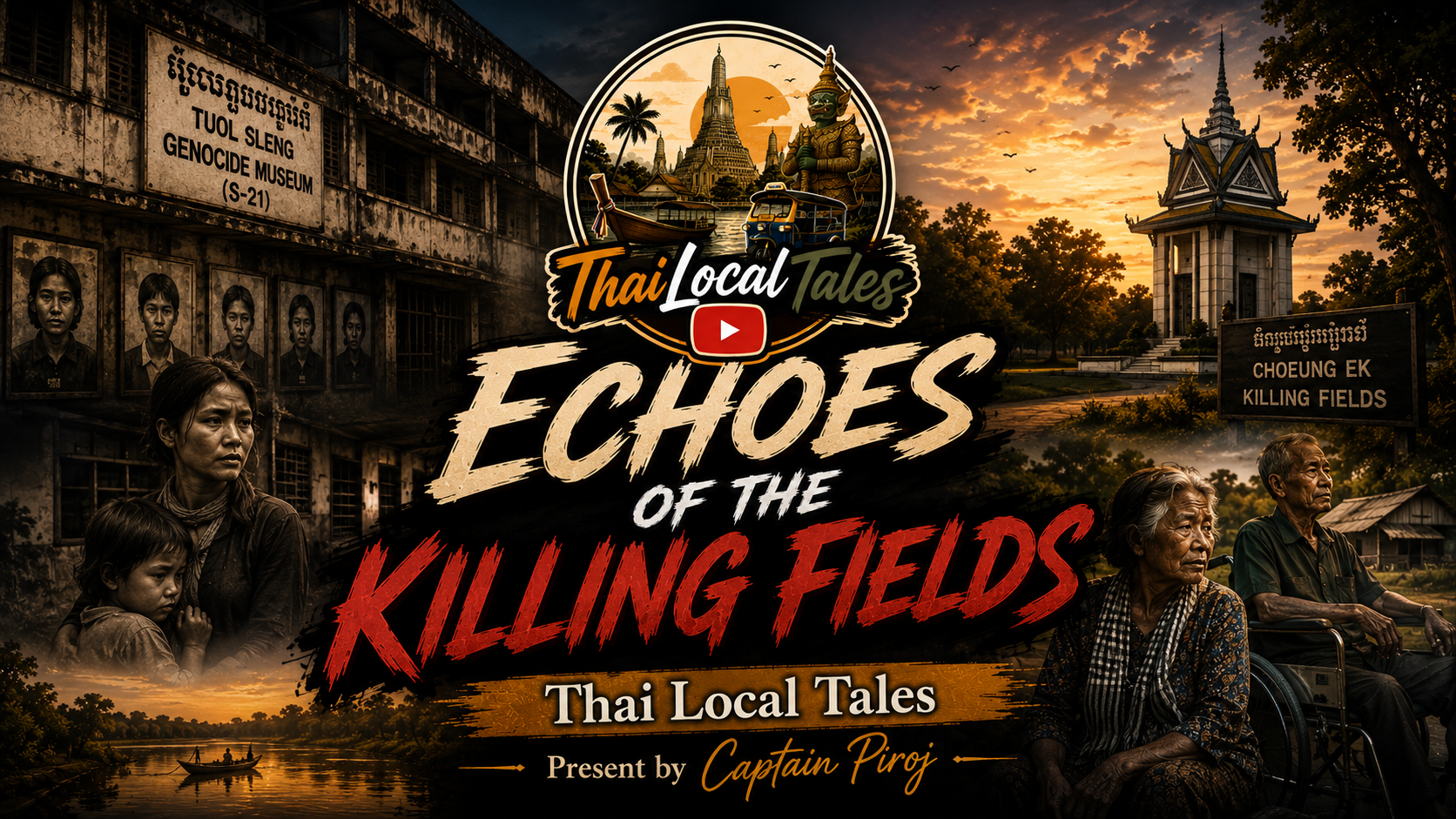
Echoes of the killing fields
July 12, 2026
Today, I will recount an important event that serves as a grim reminder of the meaning of unity. The violent division of Cambodia resulted in great tragedy for its people, giving rise to an era defined by a single, horrifying phrase: the Killing Fields. Something the world must remember. Let’s listen to what happened in Cambodia that day.
The Fall of a Nation
At that time, Cambodia was divided into two factions: the American-supported government led by General Lon Nol, and the communist-backed Khmer Rouge, led by Pol Pot. People of the same nation turned against each other with fierce hostility.
On April 17, 1975, the Khmer Rouge seized control of Phnom Penh. Initially, the people took to the streets to cheer and welcome the soldiers, fed up with the corrupt Lon Nol government that had caused so much suffering. However, their hopes were quickly dashed as they encountered something far more horrifying.
Cambodia transitioned into a radical socialist and communist state. King Norodom Sihanouk resigned as head of state, and Pol Pot, alongside other communist leaders, formed a new government, renaming the country Democratic Kampuchea. The Khmer Rouge occupied Cambodia for exactly 3 years, 8 months, and 20 days. Under their ruthless control, an estimated 2 to 3 million Cambodians lost their lives to massacres, starvation, hardship, and disease.
Tuol Sleng: The Hell Prison
Under the rule of the Khmer Rouge, Ta Mok and Mit Duc served as chief assassins. The most notorious monument to their atrocities is Tuol Sleng prison, directed by Mit Duc. Eventually, even high-ranking Khmer Rouge leaders were brought here and killed, sacrificed to appease Pol Pot’s extreme paranoia. Phnom Penh became a ghost town as citizens were forcibly relocated to the countryside to build new agrarian societies.
Originally a school, Tuol Sleng was converted into a center for the interrogation, detention, and torture of intellectual prisoners. Approximately 17,000 inmates were murdered here, averaging about 100 killings per day.
The museum today consists of three main buildings. In the front courtyard lies the tomb of the last 14 political prisoners, who were brutally murdered in various ways just before the prison was liberated.
The Halls of Torment
Building A contains single cells used to confine high-ranking officials and ministers. The rooms still hold old iron beds, chains, and small boxes used for human waste. Bloodstains remain visible under the beds. Photographs of the 14 victims hang on the walls, documenting the gruesome aftermath of their deaths. Outside, the pulleys and water jars used to suffocate victims still stand.
In Building C, rows of photographs display the faces of the condemned: men, women, young people, and the elderly. Among them were engineers, doctors, teachers, and diplomats. After seizing power, Pol Pot deceptively called for Cambodian intellectuals living abroad to return and help rebuild the nation. Those who answered the call were arrested at the airport, brought to this prison, and executed, tragically sacrificing their lives to leaders who considered intellectuals the enemies of the people.
In Building B, a massive map of Cambodia is formed entirely from thousands of human skulls. The rivers are painted red, symbolizing the streams of blood shed during the regime. Clothing stripped from the deceased is stacked high in closets, alongside the small chair where prisoners were forced to sit for their intake photographs.
Choeung Ek: The Killing Fields
About 15 kilometers from the center of Phnom Penh lies Choeung Ek, the largest execution camp and mass grave site, commonly known as the Killing Fields.
At the center of this vast, open field stands a ten-story glass memorial crematorium filled with thousands of skulls. Many skulls bear the fatal marks of gunshots or sharp objects like axes and knives. In the fields behind the memorial lie 50 deep mass graves where over 25,000 Cambodian villagers and laborers were executed and pushed into the pits. Some graves are marked with heartbreaking signs, such as “Graduation of 100 Naked Children and Women.” Fragments of bone and cloth are still mixed into the soil.
Echoes of the Survivors
Eiamchan’s Miracle
Eiamchan was a prisoner at Tuol Sleng and one of the few who miraculously survived. He was blindfolded and being led into the forest to be executed when Vietnamese forces invaded and liberated Phnom Penh, causing his executioners to flee in the chaos.
He recalled that upon entering the prison, inmates were photographed, had their information recorded, and were ruthlessly interrogated. They were electrocuted if they refused to answer.
“I was chained up in my room. I didn’t shower for three full years. Then, the Khmer Rouge soldiers would pour water over me, making me soaking wet and itchy all over.”
Prisoners received only two meager meals a day of watery rice porridge. Eiamchan was subjected to horrific abuse, including being forced to drink excess water and being shocked with electric wires, leaving him with lasting trauma.
“I was utterly hopeless. Every night I’d imagine waking up to die. I desperately wanted to die, yet I also wanted to endure the torment. In prison, I was so thin, just skin and bones. My limbs were withered and emaciated. I wasn’t much different from an animal.”
After the regime fell, Eiamchan returned to work as a museum officer at Tuol Sleng, painting murals to document the atrocities. However, the haunting memories and constant hallucinations of his murdered friends eventually forced him to quit and seek a quieter life as an independent sculptor.
Uncle Rit’s Scars
The war left indelible marks not just in memories, but on flesh. Uncle Rit bears severe facial scarring from exposure to “chemical rain”—Agent Orange dropped by American planes years earlier. The glowing orange drops burned his skin, leaving him in excruciating pain and causing permanent tissue death.
Tragically, Uncle Rit also lost his wife and one-year-old daughter in a brutal van ambush. Though many speculated the Khmer Rouge were responsible, Uncle Rit believes it was likely robbers.
“I’m not angry because I don’t know which side did it. My wish is for all the factions of Cambodia to unite and work together to develop the country.”
John the Soldier
John is a blind, double-amputee veteran who joined the army at just 14 years old to fight the Khmer Rouge. He recalls the sheer brutality of the Khmer Rouge soldiers, who would destroy entire villages, executing or raping women in their path.
“If my eyes weren’t damaged and my legs weren’t disabled, I would want to join the army again and kill the Khmer Rouge.”
Grandma Suan’s Silent Tears
Grandma Suan, now in her seventies, lived through the horrors in Battambang. She remembers the night black-clad Khmer Rouge soldiers stormed her village. Her husband was tricked into leaving their home and was summarily executed.
To survive, she had to suppress her grief. Even upon seeing her husband’s body, she didn’t dare cry, knowing it would make her the next target. She witnessed unimaginable atrocities and survived by secretly foraging for water hyacinth and wild yams.
When recounting her past, she pointed to the majestic mountains behind her home, noting that they were, in reality, a graveyard hiding the bones of thousands of murder victims.
A Hope for the Future
Every elderly person in these nursing homes has endured similar tragic journeys. We can only hope that this scarred land will one day become a fertile ground for love, unity, and solidarity—a Cambodia that finally enjoys true peace, freedom, and independence in the future.